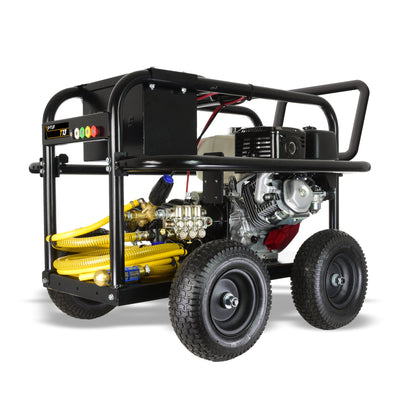
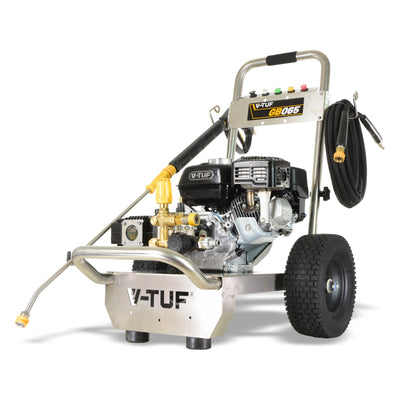
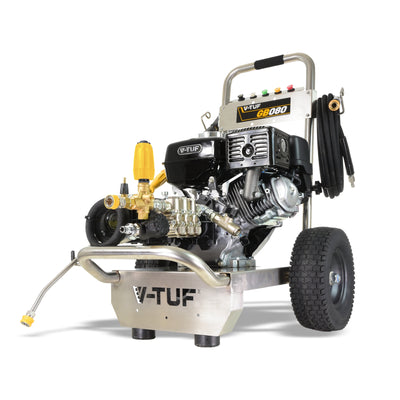
V-TUF T13 200 Bar 21L/min 13HP Honda gearbox petrol washer VTUFT13-GB200 roll cage with electric start

V-TUF T13 13HP Honda Petrol Pressure Washer with Gearbox - 250Bar, 15L/min, Roll Cage Frame & Electric Start - Petrol Engine

£2,496.66 Ex. VAT
£2,995.99 Inc. VAT
Sale price  £2,496.66 Regular price  £0.00 Ex. VAT
£2,995.99 Inc. VAT
Skip to product information
V-TUF T13 200 Bar 21L/min 13HP Honda gearbox petrol washer VTUFT13-GB200 roll cage with electric start

V-TUF T13 13HP Honda Petrol Pressure Washer with Gearbox - 250Bar, 15L/min, Roll Cage Frame & Electric Start - Petrol Engine

Low stock
Delivery: 3-4 days
Code: VTUFT13-GB250
£2,496.66 Ex. VAT
£2,995.99 Inc. VAT
Regular price  £0.00 Sale price  £2,496.66 Ex. VAT
£2,995.99 Inc. VAT
Share:

Key Features

  • GENUINE V-TUF T13-GB250 – Honda 13HP gearbox petrol pressure washer, roll cage, electric start
  • 250 BAR, 21 L/MIN – for demanding professional contractor use
  • ROLL CAGE FRAME – maximum durability and protection
  • FOR 200 BAR VERSION – see T13-GB200
  • GENUINE V-TUF MACHINE – 1-year warranty, supplied from our Lincoln warehouse

Customise with optional extras:

V-TUF Customer Support

Not sure what you need for the job?
Give our UK based support team a call on 01522 787 978, and we will walk you through step by step. Alternatively you can send us a message. We will respond between 8am to 4.30pm; Monday to Friday.

Description
Specifications
Industries
  • Construction
  • Fleet depots
  • Agriculture
  • Cleaning trade
Legislation
  • Environmental Permitting Regulations 2016
  • COSHH Regulations 2002
  • Working at Height Regulations 2005
Warranty
12 Months
Powered by
Petrol
Litres per minute
21
Operating pressure
200 bar
Working pressure
250
Working Pressure (Bar)
250
Hot cold water
Cold Water
Chemical application
Total stop system
Weight
125kg
Water supply type
Mains Feed Only
Engine motor size
13 HP
Product dimensions
900 x 680 x 1000mm
Power Output (W)
8700
Horsepower (HP)
13.0
Flow rate
900.0
Flow Rate (L/min)
21.0
Engine
GX390QXES -13Hp Electric start
Hose (Metre Length)
10
Voltage
Petrol Engine
Motor type
Honda 13HP (gearbox driven)
Fuel type
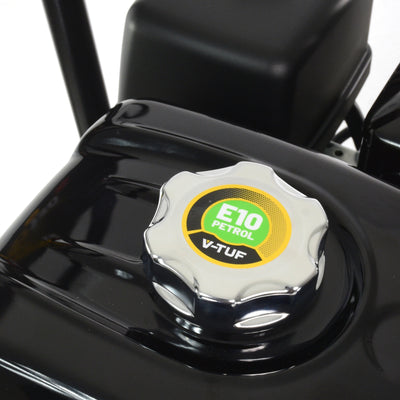
Petrol
Maximum Water Temperature (°C)
60
Start facility
Electric start
Downloads

Compare

  • V-TUF T13 13HP Honda Petrol Pressure Washer with Gearbox - 250Bar, 15L/min, Roll Cage Frame & Electric Start - Petrol Engine
    £2,496.66 Ex. VAT
    £2,995.99 Inc. VAT
    Regular price  £0.00 Sale price  £2,496.66 Ex. VAT
    £2,995.99 Inc. VAT
    Code: VTUFT13-GB250
    Industries
    • Construction
    • Fleet depots
    • Agriculture
    • Cleaning trade
    Features
    Description
    A gearbox-driven petrol pressure washer with roll cage and electric start — ideal for professional contractors needing maximum durability.V-TUF T13-GB250 (T13-GB250) is a 13HP Honda gearbox-driven petrol pressure washer with roll cage frame and electric start, delivering 250 Bar and 15 L/min for ...
    Read More
    Chemical Application
    Hot/Cold Water Cold Water
    Litres/Per Minute 21
    Operating Pressure 200 bar
    Powered By Petrol
    Product Dimensions 900 x 680 x 1000mm
    Sound Level (dB(A)) N/A
    Total Stop System
    Warranty 12 Months
    Water Supply Type Mains Feed Only
    Weight 125kg
    Power Output (W) -
    View Details

Related Items

Frequently Asked Questions

What pressure do I need for my application?

For most domestic and light commercial applications — patios, driveways, vehicles, garden furniture — machines in the 100–150 bar range are correct. For heavy commercial use — fleet vehicles, construction site equipment, agricultural machinery, industrial surfaces — 150–200 bar and above is appropriate.

Higher pressure is not always better. Soft surfaces — render, painted surfaces, wood decking, vehicles — can be damaged by excessive pressure. Always start at a lower pressure setting and increase as needed. Use a wide fan nozzle rather than a pencil jet on delicate surfaces.

Flow rate (litres per minute) matters as much as pressure for cleaning large areas efficiently. A higher flow rate rinses contamination away faster. For large area cleaning — car parks, yard surfaces, estate roads — prioritise flow rate alongside pressure.

What is the difference between a cold water and hot water pressure washer?

Cold water pressure washers use mains-temperature water to remove surface contamination by mechanical force. They are effective for general dirt, mud, algae and loose surface contamination.

Hot water pressure washers heat the water to 80–155°C before delivery. Hot water cuts through grease, oil, fat and biological contamination significantly faster than cold water alone — in the same way washing greasy dishes in hot water works better than cold. Hot water also kills bacteria and pathogens on contact, making it the correct specification for food production areas, kennels, stables, veterinary practices and any application where hygiene rather than just cleaning is the requirement.

For vehicle and plant washing, kitchen external areas, bin compounds, kennel runs and animal housing — hot water is the correct specification. For general outdoor surfaces, driveways and vehicle exteriors where grease is not the primary contamination — cold water is sufficient.

Can I use chemicals and detergents with my pressure washer?

Yes — most V-TUF pressure washers have a chemical injection system or downstream detergent injector that allows cleaning chemicals to be applied through the machine at low pressure. Apply chemicals at low pressure with a wide fan nozzle, allow dwell time, then rinse at full pressure.

Use only chemicals designed for pressure washer use. Never use acids, solvents or bleach through a machine that is not rated for those chemicals — they will damage seals, pumps and internal components and void the warranty.

Under the Environmental Permitting Regulations, wash-down water containing detergents or chemicals must not enter surface water drains or watercourses. Ensure wash-down water is directed to a foul water drain or contained for proper disposal.

What is the difference between a petrol and electric pressure washer?

Electric pressure washers require a mains power supply. They are quieter, produce no exhaust emissions, and are the correct choice for indoor use, covered areas, and anywhere with reliable mains power access. Available in 240V and 110V site-safe versions.

Petrol pressure washers are fully mobile — no power cable, no dependence on a mains supply. They are the correct choice for large outdoor areas, remote locations, agricultural and equestrian use, event venues, and any application where trailing a power cable is impractical or unsafe. Petrol machines must not be used in enclosed or poorly ventilated spaces due to exhaust emissions.

For most static commercial applications with mains power — electric. For mobile, outdoor or remote applications — petrol.

What do I do if my pressure washer loses pressure?

The most common causes of pressure loss are: a blocked or worn nozzle, a partially closed water supply, a kinked or restricted inlet hose, a worn pump seal, or air in the system.

Start by checking the water supply — the machine needs a consistent, unrestricted flow. Check the inlet filter for debris. Remove and inspect the nozzle — a worn or blocked nozzle is the most frequent cause of pressure loss and is an inexpensive fix. Run water through the gun without the nozzle to check if pressure is present at the gun.

For further troubleshooting, visit the V-TUF support hub or call our Lincoln service team on 01522 787978. Spare nozzles, seals and inlet filters are available for next-day dispatch.

What nozzle do I use for different surfaces?

0° (red) — pencil jet for maximum impact on a single point. For removing stubborn deposits, chewing gum or heavy build-up from hard surfaces only. Never use on vehicles, wood, render or any surface that could be damaged by concentrated pressure.

15° (yellow) — narrow fan for heavy cleaning of concrete, stone and industrial surfaces. Use with care on softer materials.

25° (green) — medium fan for general purpose cleaning of most hard surfaces — patios, driveways, walls, equipment. The most commonly used nozzle for day-to-day cleaning.

40° (white) — wide fan for delicate surfaces, vehicles, windows and garden furniture. Lower impact pressure reduces the risk of surface damage.

65° (black) — chemical injection nozzle. Applies cleaning chemicals at low pressure. Always use this nozzle when applying detergents — never use a narrow nozzle with chemicals as the high pressure creates a fine mist that increases chemical inhalation risk.

Can I use a pressure washer indoors?

Electric pressure washers can be used indoors in appropriate conditions — food production facilities, commercial kitchens, kennel runs, dairy parlours and other hard-surfaced industrial environments with proper drainage. Ensure adequate ventilation to allow steam and moisture to escape and surfaces to dry.

Petrol and diesel pressure washers must never be used indoors or in enclosed spaces — the exhaust emissions are toxic and in an enclosed space will rapidly reach dangerous concentrations.

For indoor use, ensure all electrical fittings, sockets and equipment in the area are protected from water spray before starting. Use the 110V version on construction sites and in refurbishment environments.

What is softwash and when should I use it instead of high pressure?

Softwash is low-pressure application of a biocidal cleaning solution that kills algae, moss, lichen and other biological growth at the root. Instead of blasting biological growth off a surface with high pressure — which leaves the root system intact and allows rapid regrowth — softwash kills the organism so regrowth is significantly slower.

Softwash is the correct approach for render, painted masonry, cladding, roof tiles, timber and other surfaces that can be damaged by high pressure. High pressure on render can blast out mortar, damage the render surface and force water behind the render skin.

Apply softwash chemical at low pressure through the chemical injection nozzle (65°), allow the solution to dwell and work — typically 15–30 minutes — then rinse at low to medium pressure. The biological growth will continue to die back and wash away with rainfall over the following weeks.

What warranty does the machine come with?

V-TUF machines come with a 1-year manufacturer's warranty covering defects in materials and workmanship under normal use conditions. The warranty does not cover damage from misuse, incorrect voltage supply, use with non-approved chemicals, or failure to maintain the machine in accordance with the user manual.

V-TUF holds spares for every machine in current production. Call our Lincoln service team on 01522 787978 for warranty claims, spare parts and technical support.

Where can I get spare parts and accessories?

V-TUF holds spare parts for every machine in current production at our Lincoln warehouse. Spare parts and accessories are available through the V-TUF website or by calling our Lincoln service team on 01522 787978.

For urgent spare parts requirements, call the service team directly — next-day dispatch is available for stocked parts. Quote your machine model and serial number when ordering.

What is PUWER and does it apply to my equipment?

PUWER — the Provision and Use of Work Equipment Regulations 1998 — applies to any equipment used at work. It requires that work equipment is suitable for its intended purpose, maintained in safe working order, inspected at appropriate intervals, and operated only by personnel who have received adequate training and information.

PUWER applies to V-TUF pressure washers, vacuums, dust extractors and spray extraction machines when used in a work context — including by sole traders, contractors and employees. It does not apply to domestic use in a private home.

In practice, PUWER compliance means: use the machine only for its intended purpose, carry out the maintenance specified in the user manual, keep a record of maintenance and inspection, and ensure operators are trained before use. The V-TUF TotalCare managed equipment programme includes annual safety inspection and maintenance records that directly support PUWER compliance.

What is the difference between 110V and 240V?

240V is the standard UK mains voltage — suitable for any location with a mains socket. This is the correct choice for use in domestic properties, offices, kennels, grooming salons, workshops and most commercial premises.

110V is the mandated voltage for portable electrical equipment on UK construction and maintenance sites under the Electricity at Work Regulations 1989. A 110V centre-tapped earth (CTE) supply from a yellow site transformer limits the shock voltage to 55V, significantly reducing the risk of fatal electric shock in wet or outdoor site conditions.

If you are working on a construction site, in a void property under active refurbishment, or anywhere a site manager has specified 110V — use the 110V model. Do not use a 240V machine on a site where 110V is specified.

Do I need a transformer to use a 110V machine?

Yes — 110V machines require a 110V centre-tapped earth (CTE) site transformer to operate. These are standard equipment on UK construction and maintenance sites and are available from tool hire companies. Do not attempt to connect a 110V machine directly to a 240V mains supply.

If you are not working on a construction site and do not have a site transformer, the 240V model is the correct choice.