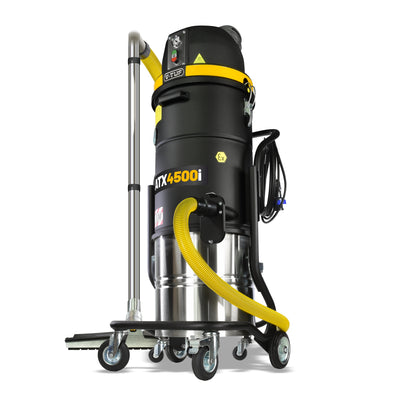
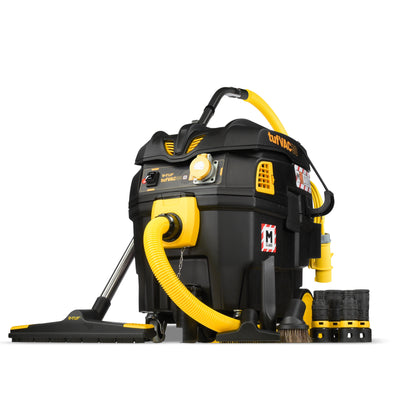
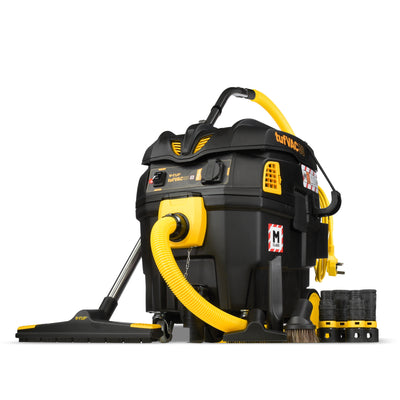
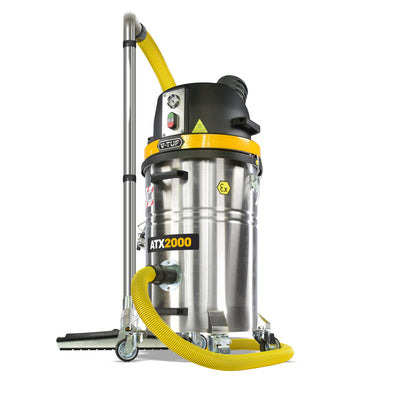
V-TUF ATX4500i 45L M-Class 240V ATEX Z22 vacuum ATX4500I-240 with detachable bin, front view

V-TUF ATX4500i 45L Industrial M-Class 1100w Industrial Dust Extraction Vacuum Cleaner with Detachable Bin & Filter Cleaning - ATEX Rating Z22 - 240V Mains

£4,166.66 Ex. VAT
£4,999.99 Inc. VAT
Sale price  £4,166.66 Regular price  £0.00 Ex. VAT
£4,999.99 Inc. VAT
Skip to product information
V-TUF ATX4500i 45L M-Class 240V ATEX Z22 vacuum ATX4500I-240 with detachable bin, front view

V-TUF ATX4500i 45L Industrial M-Class 1100w Industrial Dust Extraction Vacuum Cleaner with Detachable Bin & Filter Cleaning - ATEX Rating Z22 - 240V Mains

Backorder
Code: ATX4500I-240
£4,166.66 Ex. VAT
£4,999.99 Inc. VAT
Regular price  £0.00 Sale price  £4,166.66 Ex. VAT
£4,999.99 Inc. VAT
Share:

Key Features

  • ATEX ZONE 22 CERTIFIED – ATEX-certified i-series build, rated for use in Zone 22 explosive dust atmospheres.
  • M-CLASS FILTRATION – M-Class HEPA filtration, compliant for hazardous construction dust.
  • 45-LITRE STAINLESS BODY – 45 litre stainless steel body with a detachable bin for emptying.
  • 1100W BRUSHLESS MOTOR – 1100W brushless motor running from a 240V mains supply.
  • AUTOMATIC FILTER SHAKER – Maintains suction during use; 5m x 38mm hose, wand set and tool kit supplied.

Customise with optional extras:

V-TUF Customer Support

Not sure what you need for the job?
Give our UK based support team a call on 01522 787 978, and we will walk you through step by step. Alternatively you can send us a message. We will respond between 8am to 4.30pm; Monday to Friday.

Description
Specifications
Industries
  • Food & beverage manufacturing
  • Manufacturing & engineering
  • Marine & shipyard
  • Construction (ATEX environments)
Legislation
  • DSEAR 2002 & ATEX
  • COSHH Regulations 2002
  • Confined Spaces Regulations 1997
  • HSE EH40 Workplace Exposure Limits
Warranty
12 Months
Powered by
240V Mains
Chemical application
Total stop system
Weight
45kg
Engine motor size
1100W
Product dimensions
1303 x 620 x 550 mm
Sound level db a
72
Power Output (W)
1100
Filtration class
M-Class ATEX
Voltage
240V Mains
Downloads

Compare

  • V-TUF ATX4500i 45L Industrial M-Class 1100w Industrial Dust Extraction Vacuum Cleaner with Detachable Bin & Filter Cleaning - ATEX Rating Z22 - 240V Mains
    £4,166.66 Ex. VAT
    £4,999.99 Inc. VAT
    Regular price  £0.00 Sale price  £4,166.66 Ex. VAT
    £4,999.99 Inc. VAT
    Code: ATX4500I-240
    Industries
    • Food & beverage manufacturing
    • Manufacturing & engineering
    • Marine & shipyard
    • Construction (ATEX environments)
    Features
    Description
    An ATEX-rated dust extractor — designed for explosive and hazardous environments. V-TUF ATX4500i 45L M-Class Compact Stainless 240V 1100W Industrial Dust Extractor (ATX4500i-240) is an ATEX-certified i-series brushless M-Class industrial vacuum in a stainless steel body for use in hazardous areas...
    Read More
    Chemical Application
    Litres/Per Minute N/A
    Operating Pressure N/A
    Powered By 240V Mains
    Product Dimensions 1303 x 620 x 550 mm
    Sound Level (dB(A)) 72
    Total Stop System
    Warranty 12 Months
    Weight 45kg
    View Details

Related Items

Frequently Asked Questions

What is M-Class dust extraction?

M-Class (Medium hazard) is a dust extraction filtration standard defined under EN 60335-2-69. An M-Class certified extractor captures at least 99.9% of dust particles, including fine construction dusts such as wood dust, concrete dust and general silica-containing materials generated by cutting, grinding, sanding and drilling.

M-Class extraction is the minimum standard required under COSHH Regulations 2002 and HSE guidance L143 for work with medium-hazard dusts on construction sites, in workshops and in occupied buildings. It is also the specification required under CDM 2015 for dust-generating work.

M-Class is not suitable for asbestos, mould spores or other Category 3 biological agents — H-Class is required for those applications.

What is H-Class dust extraction?

H-Class (High hazard) is the highest dust extraction filtration standard under EN 60335-2-69. An H-Class certified extractor captures at least 99.995% of dust particles, including carcinogenic and highly toxic dusts that M-Class cannot safely contain.

H-Class is legally required for work with asbestos-containing materials under the Control of Asbestos Regulations 2012, for mould remediation (mould spores are Category 3 biological agents under COSHH), and for any dust classified as a carcinogen or mutagen under COSHH Regulations 2002.

H-Class machines use sealed HEPA filtration systems. The filter and dust bag must be disposed of as hazardous waste without opening — the sealed disposal system is part of the H-Class specification.

What is the difference between M-Class and H-Class dust extraction?

M-Class captures 99.9% of dust and is correct for medium-hazard dusts — wood dust, concrete dust, silica from cutting and grinding. H-Class captures 99.995% and is correct for high-hazard dusts — asbestos, mould spores, carcinogenic materials.

The practical rule: if you are in any doubt about the hazard level of the dust you are generating, use H-Class. If your site manager or principal contractor has specified H-Class, use H-Class regardless of your own assessment. M-Class is not an acceptable substitute for H-Class work.

In buildings constructed before 2000, asbestos-containing materials may be present in textured coatings, floor tiles, insulation and other building fabric. Any dust-generating work in pre-2000 buildings should use H-Class extraction until the presence of asbestos has been ruled out by a survey.

Do I need an M-Class or H-Class vacuum for my job?

M-Class is required for medium-hazard dusts — wood dust, concrete dust, silica from cutting and grinding, gypsum, general construction dust. This covers most dust-generating work on construction sites, in workshops and in occupied buildings under CDM 2015 and COSHH Regulations.

H-Class is required for high-hazard dusts — asbestos (mandatory under Control of Asbestos Regulations 2012), mould spores (Category 3 biological agents under COSHH), and any dust classified as a carcinogen or mutagen.

The practical rule: if your site manager or principal contractor specifies H-Class, use H-Class. In any pre-2000 building where asbestos has not been ruled out by a survey, use H-Class for all dust-generating work. If you are not sure, H-Class is always the safer and legally defensible choice.

What is the difference between a wet/dry vacuum and a dust extractor?

A wet/dry vacuum is a general-purpose industrial vacuum designed to collect both liquid and dry debris — water, slurry, dust, chips, shavings and general workshop waste. It is not classified to a filtration standard and is not suitable for hazardous dusts.

A dust extractor is a purpose-built tool for capturing hazardous dust at source during cutting, grinding, sanding and drilling operations. Dust extractors are certified to M-Class or H-Class filtration standards under EN 60335-2-69, meaning they capture a defined minimum percentage of fine dust particles before they reach the operator's breathing zone.

For COSHH-regulated dust-generating work — including CDM 2015 construction sites, occupied buildings and work with silica-containing materials — a certified M-Class or H-Class dust extractor is required by law. A wet/dry vacuum is not an acceptable substitute.

What size vacuum do I need?

Tank capacity determines how long you can work before emptying. For general workshop and site use, 20–40 litre tanks are practical for most applications. For sustained heavy-duty use across a full working day — large sites, multiple operatives, high-volume debris — 60–80 litre tanks reduce downtime from frequent emptying.

Motor power determines suction performance on heavier debris and over longer hose runs. Twin-motor machines maintain higher suction levels and are better suited to sustained commercial use. Single-motor machines are lighter and more portable, suited to lighter applications and where portability matters.

For guidance on the right machine for your specific application, call our Lincoln service team on 01522 787978.

How often do I need to empty and clean the vacuum filter?

Filter maintenance frequency depends on the type and volume of material being collected. For fine dust applications — cutting, grinding, sanding — filters should be checked and cleaned at the end of every working session. A blocked filter reduces suction performance significantly and increases the risk of dust bypassing the filter.

Many V-TUF machines have an automatic filter shaker that cleans the filter during use, maintaining suction performance without stopping work. Check the user manual for your specific model.

For H-Class vacuums used on asbestos or mould remediation: the filter and dust bag must be disposed of as hazardous waste without opening at the end of each job. Never clean or reuse H-Class filters from hazardous dust applications.

Can I use my vacuum to collect water and wet debris?

V-TUF wet/dry vacuums are designed for both wet and dry use. For wet use, ensure the correct filter configuration is in place as specified in the user manual — typically the foam filter is removed or a wet filter fitted for liquid collection. Operating with a dry filter in wet conditions will saturate the filter, block airflow and damage the motor.

Dust extractors (M-Class and H-Class) are dry use only and must never be used to collect liquids.

Check the product specification and user manual for your specific model to confirm wet use capability and the correct filter configuration before use.

Can I connect my vacuum directly to a power tool?

Many V-TUF dust extractors have an auto-start function that connects to a power tool via a tool-triggered socket. When the power tool is switched on, the vacuum starts automatically. When the tool stops, the vacuum continues briefly to clear residual dust from the hose before stopping.

Check the power rating of the tool-triggered socket on your specific model before connecting a power tool — the socket has a maximum load rating and overloading it will trip the circuit.

For connection to power tools, use the correct diameter hose adapter for your tool's dust extraction port. V-TUF supplies a range of hose adapters and anti-static hoses for tool connection. Call 01522 787978 or check the accessories section for your machine.

What is the correct way to dispose of the dust bag and filter after H-Class use?

After H-Class use on asbestos, mould or other Category 1/3 hazardous materials, the dust bag and filter must be treated as hazardous waste. Do not open the bag or shake the filter — this releases captured hazardous material back into the air.

The correct procedure is to seal the bag inside the machine before removal, place it directly into a sealed hazardous waste bag, label it correctly and dispose of via a licensed hazardous waste contractor. The filter should be sealed in a separate bag and disposed of in the same way.

For asbestos waste specifically, disposal must comply with the Control of Asbestos Regulations 2012 and the Hazardous Waste Regulations 2005. Only licensed waste carriers may transport asbestos waste. Contact your principal contractor or the HSE for guidance on licensed disposal routes.

My vacuum has lost suction — what should I check first?

The most common causes of suction loss are a blocked or saturated filter, a full tank, a blockage in the hose or tool connection, or a split or poorly connected hose.

Start by checking the filter — remove it and clean or replace it. Check the tank level — a full tank will significantly reduce suction. Disconnect the hose and check for blockages by running the vacuum without the hose attached. If suction is strong without the hose, the blockage is in the hose or tool connection.

For further troubleshooting, visit the V-TUF support hub or call our Lincoln service team on 01522 787978. Replacement filters, bags and hoses are available for next-day dispatch.

What accessories are available for my vacuum?

V-TUF supplies a full range of accessories for every vacuum in the current range — replacement filters, dust bags, hoses, crevice tools, upholstery attachments, floor heads, round brushes and hose adapters for tool connection. Spare parts and accessories are held in stock at our Lincoln warehouse for next-day dispatch.

To find the correct accessories for your specific model, check the accessories section on your product page or call our Lincoln service team on 01522 787978 with your machine model and serial number.

Can I use my vacuum outdoors?

Most V-TUF wet/dry vacuums are suitable for outdoor use in dry conditions. Check the IP rating for your specific model — machines with an IP rating of IP24 or above provide splash protection suitable for outdoor use in light rain or wet environments.

Do not use any vacuum in standing water or in conditions where the machine itself could become submerged. For outdoor dust-generating work, ensure the machine and its electrical connections are kept away from direct rainfall.

For outdoor use on construction sites, the 110V version with a site transformer is the correct specification under the Electricity at Work Regulations 1989.

What warranty does the machine come with?

V-TUF machines come with a 1-year manufacturer's warranty covering defects in materials and workmanship under normal use conditions. The warranty does not cover damage from misuse, incorrect voltage supply, use with non-approved chemicals, or failure to maintain the machine in accordance with the user manual.

V-TUF holds spares for every machine in current production. Call our Lincoln service team on 01522 787978 for warranty claims, spare parts and technical support.

Where can I get spare parts and accessories?

V-TUF holds spare parts for every machine in current production at our Lincoln warehouse. Spare parts and accessories are available through the V-TUF website or by calling our Lincoln service team on 01522 787978.

For urgent spare parts requirements, call the service team directly — next-day dispatch is available for stocked parts. Quote your machine model and serial number when ordering.

How do I register my machine for warranty?

V-TUF machines are covered by a 1-year manufacturer's warranty from the date of purchase. To register your machine or make a warranty claim, contact our Lincoln service team with your machine model, serial number and proof of purchase.

Telephone: 01522 787978. Email through the contact page on v-tuf.co.uk. Retain your order confirmation or purchase receipt as proof of purchase — this will be required for any warranty claim.

What is PUWER and does it apply to my equipment?

PUWER — the Provision and Use of Work Equipment Regulations 1998 — applies to any equipment used at work. It requires that work equipment is suitable for its intended purpose, maintained in safe working order, inspected at appropriate intervals, and operated only by personnel who have received adequate training and information.

PUWER applies to V-TUF pressure washers, vacuums, dust extractors and spray extraction machines when used in a work context — including by sole traders, contractors and employees. It does not apply to domestic use in a private home.

In practice, PUWER compliance means: use the machine only for its intended purpose, carry out the maintenance specified in the user manual, keep a record of maintenance and inspection, and ensure operators are trained before use. The V-TUF TotalCare managed equipment programme includes annual safety inspection and maintenance records that directly support PUWER compliance.

What is the difference between 110V and 240V?

240V is the standard UK mains voltage — suitable for any location with a mains socket. This is the correct choice for use in domestic properties, offices, kennels, grooming salons, workshops and most commercial premises.

110V is the mandated voltage for portable electrical equipment on UK construction and maintenance sites under the Electricity at Work Regulations 1989. A 110V centre-tapped earth (CTE) supply from a yellow site transformer limits the shock voltage to 55V, significantly reducing the risk of fatal electric shock in wet or outdoor site conditions.

If you are working on a construction site, in a void property under active refurbishment, or anywhere a site manager has specified 110V — use the 110V model. Do not use a 240V machine on a site where 110V is specified.

Do I need a transformer to use a 110V machine?

Yes — 110V machines require a 110V centre-tapped earth (CTE) site transformer to operate. These are standard equipment on UK construction and maintenance sites and are available from tool hire companies. Do not attempt to connect a 110V machine directly to a 240V mains supply.

If you are not working on a construction site and do not have a site transformer, the 240V model is the correct choice.